- Clayton's Newsletter
- Posts
- Wednesday Wisdom
Wednesday Wisdom
Open your mind to Janusian Logic
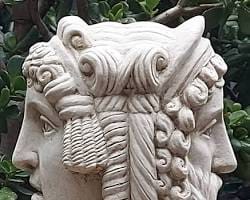
Janus, the ancient Roman god was one of the few deities unique to Roman mythology with no direct Greek equivalent. He is famously depicted with two faces, one gazing into the past and the other looking toward the future. He symbolizes his ability to oversee duality of time, being able to look into the past and the future. The month of January derives its name from him, as he presided over the start of the new year and was able to look in the past. He was the god of beginnings and ends and transition of time from childhood to adulthood. In Roman tradition, his temple was in the Roman Forum, and he was deemed the guardian of gates and thresholds. Janus embodied not just physical entrances and exits but also broader concepts of transformation, reflection, and the inevitable flow from one era or moment to the next. So, we begin the calendar year in January in honor of the god of transition and the concept of duality both in thought and time, perhaps why the concept of a new year’s resolution falls on the shoulders of Janus.
Albert Rothenburg is a Harvard professor of psychology who specializes in the field of creativity. He conducted extensive, long-term empirical studies and interviews with over 45 Nobel laureates across physics and medicine to map their thought patterns during the moment of discovery. He proposed his findings as Janusian Thinking or logic, which is the capacity to conceive two or more opposite ideas as simultaneously true. His 1979 book, The Emerging Goddess: The Creative Process in Art, Science, and Other Fields, is considered a seminal text in the psychology of creativity.
Unlike standard logic, which usually seeks to resolve a contradiction by choosing one side or finding a middle ground, Janusian logic treats opposites as equally true and important at the same time. It doesn’t put facts into a sequence such as if A is true than B must also be true. Janusian logic looks to examine how A and B interact to give a creative truth. It looks to explore the tension between the two opposites acts as a catalyst for a brand-new, original idea that transcends both original thoughts.
In 1706, the Congregationalist North Church in Boston purchased a young West African man and gifted him to the prominent Puritan minister Cotton Mather. Mather gave him the name Onesimus after a biblical slave whose name means useful. Certainly, complicit of ethical and moral dissonance, this two-faced distorted logic was justified at the time as paternalistic logic* by providing salvation to a soul over the practice of slavery. However, the story of Onesimus is not his subjugation but is highlighted by the presentation of Janusian logic and his contribution to science. In 1721 the British frigate HMS Seahorse arrived from Barbados and brought smallpox to Boston throwing the city into a panic. Smallpox was the greatest terror of the age, killing roughly 30% of those it infected. Onesimus explained to Mather that in his homeland (likely present-day West Africa countries of Ghana or Libya), it was common to take material from an infected person’s pustule and rub it into a small cut on a healthy person’s arm. This would cause a mild case of the disease but give lifelong immunity. To Mather’s credit, he tried to persuade local physicians of Onesimus’s logic in defeating the plague and i saving lives. Only one physician, Zabdiel Boylston, agreed to try it first by inoculating his own son and then two enslaved people. The results were stark and persuasive, un-inoculated Bostonians, roughly 1 in 7 died while inoculated Bostonians, only 1 in 40 passed away. More people could have been saved had they embraced the logic that of Onesimus that opposite truths can exist.
Janusian Logic brings creativity to science
Albert Einstein developed the General Theory of Relativity in 1915 by imagining a man falling off a roof. He realized the man was simultaneously in motion and at rest relative to himself. It provided an explanation to Newtonian theory of gravity and acceleration while reminding us that we live on a spinning planet, we are both still and accelerating at the same time. Einstein like many other prominent scientists were frustrated by the contradictory world of subatomic particles and quantum physics.
Niels Bohr’s Principle of Complementarity suggests that subatomic entities, such as electrons, possess dual properties of being both a wave and a particle simultaneously. This theory asserts that the specific property we observe depends entirely on the experimental arrangement, meaning that these contradictory "faces" of nature can never be seen at the same time, but only through the lens of their unique interactions. Bohr’s theory changed how we perceive truth itself by exploring the subatomic world. By proving that two contradictory ideas of waves and particles could both be true, the "either/or" logic that had dominated Western philosophy since Aristotle was not exclusive.

Quantum superposition is the principle that a subatomic particle exists in every possible state or location simultaneously until the moment it is measured or observed, at which point it collapses into a single and definite state. In 1935 Erwin Schrödinger proposed his "cat" thought experiment to highlight what he saw as the absurdity or incompleteness of quantum mechanics. It may be the most famous cultural example of Janusian logic where the “cat” in a box is neither alive nor dead as a way of illustrating how subatomic particles behave.
Bohr famously is quoted, "The opposite of a correct statement is a false statement, but the opposite of a profound truth may well be another profound truth." Rothenberg sees this quote as the ultimate manifesto of Janusian logic where the friction between two "profound truths" or opposites creates a higher level of understanding. During a conversation, Mather asked Onesimus if he had ever had smallpox. Onesimus replied "Yes and no... I have undergone an operation, which had given me something of the smallpox and would forever preserve me from it."
Can Janusian Logic help with the art of thinking? Two opposite truths to explain one final truth seems like a great tool!
And now you know...
*Paternalistic logic is reasoning that justifies interfering with someone’s choices or freedom, against their wishes, on the grounds that it is for their own good or in this case their salvation.
Philosophy is the art of thinking, the building block of progress that shapes critical thinking across economics, ethics, religion, and science.
METAPHYSICS: Literally, the term metaphysics means ‘beyond the physical.’ Typically, this is the branch that most people think of when they picture philosophy. In metaphysics, the goal is to answer the what and how questions in life. Who are we, and what are time and space?
LOGIC: The study of reasoning. Much like metaphysics, understanding logic helps to understand and appreciate how we perceive the rest of our world. More than that, it provides a foundation for which to build and interpret arguments and analyses.
ETHICS: The study of morality, right and wrong, good and evil. Ethics tackles difficult conversations by adding weight to actions and decisions. Politics takes ethics to a larger scale, applying it to a group (or groups) of people. Political philosophers study political governments, laws, justice, authority, rights, liberty, ethics, and much more.
AESTHETICS: What is beautiful? Philosophers try to understand, qualify, and quantify what makes art what it is. Aesthetics also takes a deeper look at the artwork itself, trying to understand the meaning behind it, both art as a whole and art on an individual level. A question an aesthetics philosopher would seek to address is whether or not beauty truly is in the eye of the beholder.
EPISTEMOLOGY: This is the study and understanding of knowledge. The main question is how do we know? We can question the limitations of logic, how comprehension works, and the ability (or perception) to be certain.